Account center
The session guard on protected routes, plus the profile, security, sessions, and notifications sections
Last updated October 20, 2026
The account management area behind sign-in, at /{locale}/dashboard/*. Reach it from "Account settings" in the navbar user menu.
Route structure
dashboard.tsx is a pathless layout route (the same technique as docs): it holds only the guard and the shell, no page content, so /dashboard itself is not a content page.
src/routes/{-$locale}/_layout/dashboard.tsx              # guard + session + shell + <Outlet/>
src/routes/{-$locale}/_layout/dashboard/index.tsx        # /dashboard → redirect to profile
src/routes/{-$locale}/_layout/dashboard/profile.tsx      # Profile
src/routes/{-$locale}/_layout/dashboard/security.tsx     # Security
src/routes/{-$locale}/_layout/dashboard/sessions.tsx     # Sessions
src/routes/{-$locale}/_layout/dashboard/notifications.tsx # Notifications (needs newsletter)
To add a section: add a nav entry in src/config/settings.ts, add a page under dashboard/, and add a title in getSettingsSectionMeta. The shell renders it automatically.
Session guard
beforeLoad in dashboard.tsx does two things:
beforeLoad: async ({ params }) => {
  assertPageEnabled('auth')
  const session = await fetchSession()
  if (!session) {
    throw redirect({ to: '/{-$locale}/auth/login', params: { locale: params.locale } })
  }
  return { session }
}
fetchSession() (src/auth/session.ts) is a server function reading the session via getAuth(env).api.getSession({ headers: getRequestHeaders() }). It has to be, because:
- the session cookie is httpOnly and unreadable from the client;
getAuthneeds per-request env (the D1 binding), which the client does not have.
The server function evaluates in place during SSR (no network round trip) and degrades to one RPC on client navigation, so both paths see the real session — the same reasoning as fetchAuthProviderAvailability.
The return value carries only the fields the pages need (id / name / email / emailVerified / image) rather than the whole session. Child pages read it via Route.useRouteContext().
The four sections
| Section | better-auth calls | Components used |
|---|---|---|
| Profile | updateUser({ name }); sendVerificationEmail({ email, callbackURL }) when unverified | Field / Input / Button / Badge |
| Security | changePassword({ currentPassword, newPassword }), changeEmail({ newEmail, callbackURL }), deleteUser() | Field / AlertDialog |
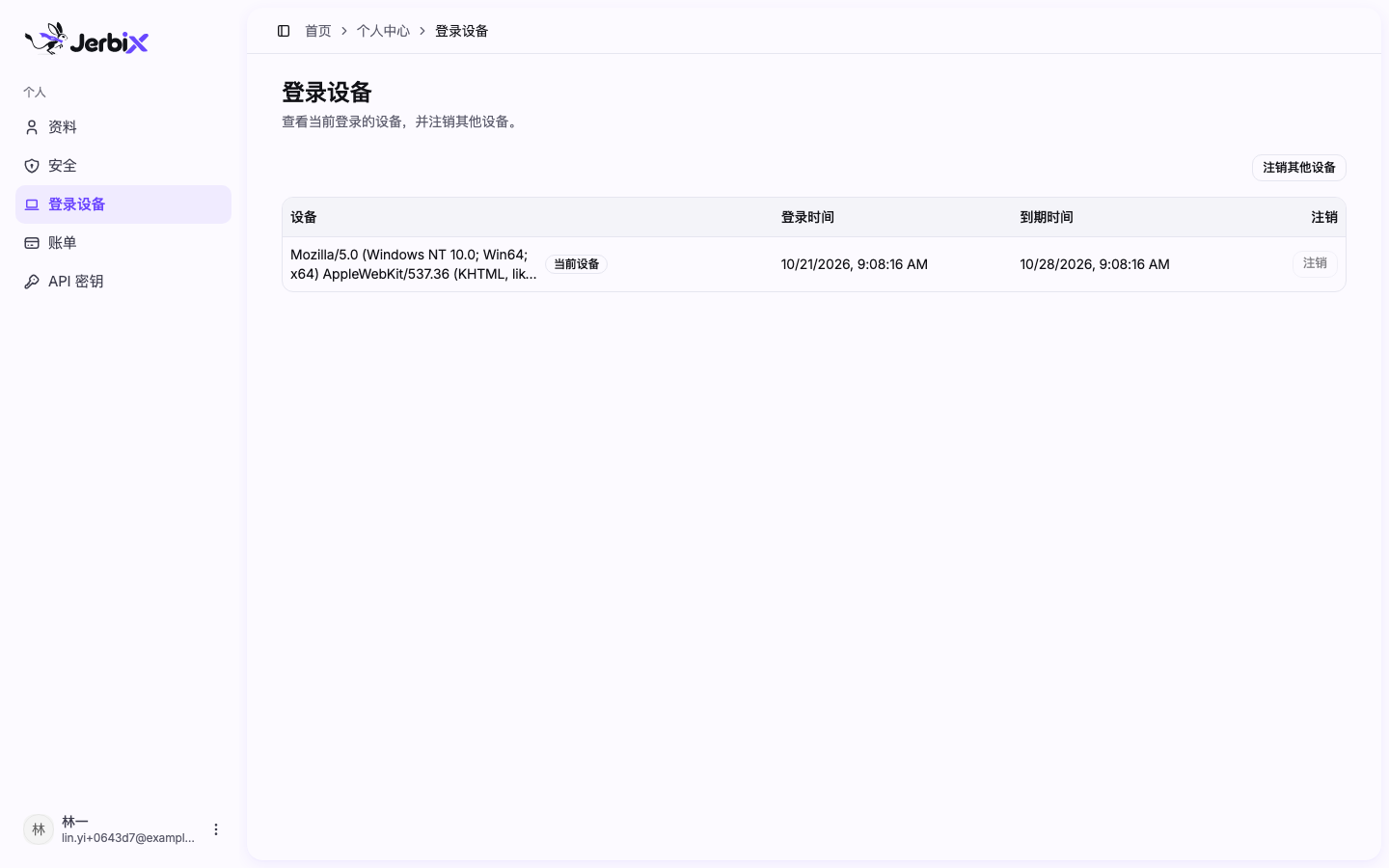
| Sessions | listSessions(), revokeSession({ token }), revokeOtherSessions() | Table / Button / Spinner |
| Notifications | GET / POST / DELETE /api/newsletter (see Newsletter) | Switch / Field |
Conventions:
- Destructive actions use
AlertDialogfor confirmation, neverwindow.confirm.
Deleting the account navigates the whole page because the session is gone.
- Status markers use
Badge(e.g. email verification state), not a hand-rolled
<span> with a background colour.
- Empty and loading states use
Spinner, not a hand-rolled placeholder. - Notifications is gated entirely by the
newslettermodule:beforeLoadcalls
assertPageEnabled('newsletter'), so when the module is off the page 404s and the menu entry disappears too (filterMenuItems filters on visibility.module).
- The current password field in change-password is only checked for presence, not against
MIN_PASSWORD_LENGTH — an old password may be shorter than the current floor, and enforcing it there would lock users out of changing their password. Only the new password uses the length floor.
Sidebar
The shell (src/components/dashboard/DashboardLayout.tsx) uses shadcn's `sidebar` (Base UI variant) directly rather than reimplementing collapse, cookie persistence, or the mobile drawer — SidebarProvider and Sidebar already provide those, switching to a Sheet on narrow screens. This file only assembles them.
It is deliberately not shared with the hand-built sidebar in DocsLayout: that one has its own cookie and collapse semantics, and merging them would only tangle both.
The sidebar has three sections, bottom-up:
| Section | Contents |
|---|---|
SidebarHeader | Site logo, links to home; white plate in dark theme (same treatment as the marketing Navbar) |
SidebarContent | The section menu described above, copy from getSettingsSections |
SidebarFooter | User card (SettingsUserCard): avatar + name + email, expand to sign out |
The user card is the only sign-out entry inside the account area — dashboard is a _layout route that does not render the marketing Navbar, so UserMenu is not visible here. The avatar comes from SessionInfo.user.image (the users.image column, written by Google sign-in); when empty it falls back to the first letter of name or email.
The top bar (the header inside SidebarInset) holds three things, left to right:
SidebarTrigger— the collapse button; click to shrink the sidebar to an icon rail,
click again to expand. Visible on every breakpoint; on narrow screens the sidebar is a Sheet drawer and needs this button to open.
- A three-level breadcrumb —
Home › Account › Current section. The first two levels are
BreadcrumbLinks, the last is a BreadcrumbPage (with aria-current="page").
ThemeToggle— top right. In the sidebar header it would fight the logo for space (the
collapsed sidebar is only ~3rem wide), and the marketing Navbar already puts it there.
The top bar has no <h1>: the last breadcrumb level is already the page title, and repeating it would surface the same word twice — once visually, once in the accessibility tree. There is also no "Back to site" link — the logo is that entry point.
Page metadata
Each child page's head() runs seo() for meta and canonical and passes noindex: true — personal pages should not be indexed.
References
- Better Auth options — account fields and session settings
- TanStack Start authentication guide —
beforeLoadguards and full-page redirects