Authentication
Email/password and Google sign-in, email flows, session guards, and form conventions
Last updated October 29, 2026
Email/password plus Google OAuth, built on Better Auth v1.7.10 with the Drizzle adapter (D1 / SQLite). Pages live at /{locale}/auth/*, the API at /api/auth/*, and the account center at /{locale}/dashboard/*.
Enabling
Authentication, Resend mail, and email verification are enabled by default:
// src/config/website.ts
auth: { enabled: true, requireEmailVerification: true },
mail: { enabled: true, provider: 'resend', supportEmail: 'service@jerbix.site' },
supportEmail is service@jerbix.site. It receives support messages and is configured separately from the sending address MAIL_FROM; see Email.
| Config / variable | When required | Purpose |
|---|---|---|
auth.enabled | — | Gates pages and API together. When off, pages 404 via assertPageEnabled('auth') and /api/auth/* returns 404 { error: 'MODULE_DISABLED' } before reaching Better Auth |
auth.requireEmailVerification | Currently defaults to true | Unverified users cannot sign in with a password — see below |
RESEND_API_KEY / MAIL_FROM | Required for the current Resend configuration | API key and a plain sender email address on a verified domain |
BETTER_AUTH_URL | Email verification / Google sign-in | http://localhost:3000 locally; the real HTTPS origin in production |
BETTER_AUTH_SECRET | Required in production | Signs sessions and email tokens, ≥ 32 characters; enforced by check:env:prod |
GOOGLE_CLIENT_ID / GOOGLE_CLIENT_SECRET | When enabling Google sign-in | OAuth credentials, both required |
When BETTER_AUTH_SECRET is unset locally, Better Auth can fall back to its development secret. Mail must still be configured in .env because email verification is required. Missing RESEND_API_KEY / MAIL_FROM, or disabled mail, makes auth report incomplete, /api/auth/* return 503, and pnpm check:env:prod fail. Verification is never implicitly disabled.
Google sign-in
The credentials must be configured as a pair. getAuthProviderAvailability returns google: true only when both the ID and the secret exist, and the login page renders the button only then. With just a client ID, Better Auth does not register the provider either, so showing the button would only funnel users into a flow that cannot succeed.
The credentials are server secrets and unreadable from the client bundle. The login page's beforeLoad calls fetchAuthProviderAvailability (a server function): it evaluates in place during SSR and degrades to one RPC on client navigation. A plain function would make the button silently disappear when entering the page from the navbar.
Email flows
Three templates, rendered by the mail provider described in Email:
| Flow | Trigger | Template |
|---|---|---|
| Email verification | On sign-up (sendOnSignUp: true); resent when an unverified user signs in with the correct password (sendOnSignIn: true) | verifyEmail |
| Password reset | "Forgot password" | forgotPassword |
| Welcome | emailVerification.afterEmailVerification, after successful email verification | welcome |
Sign-up creates the user and sends a verification email, without creating a session. An unverified user signing in with the correct password receives another verification email and 403 `EMAIL_NOT_VERIFIED`, again without a session. After successful verification, autoSignInAfterVerification: true creates a session and the welcome email is triggered. Creating a user no longer sends the welcome email.
src/auth/emails.ts is the only bridge between Better Auth callbacks and the mail registry. Two defences must stay:
- Never throw. Better Auth invokes the callbacks through
runInBackgroundOrAwait, so a
throw makes sign-up or sign-in fail. All errors collapse into { ok: false, error } plus a console.warn.
- Do not attempt delivery when mail is off or the sender is missing. The bridge returns
{ ok: false, error } and the caller logs a warning. This does not change the auth gate: requiring verification with incomplete mail makes the API return 503 before Better Auth runs.
The recipient locale is resolved from the Request passed as the callback's second argument (URL prefix → cookie → Accept-Language → default), so a Chinese visitor gets a Chinese email with no extra wiring.
Verification link
The email link points at /api/auth/verify-email?token=…&callbackURL=…, where callbackURL is the encoded /{locale}/auth/verify-email?redirect=<internal target>. Both sign-up and password sign-in preserve a safe internal purchase target. safeInternalPath() rejects external origins, //, backslashes, and control characters; absent or invalid targets fall back to /.
This is a GET endpoint on the Better Auth side: it verifies then redirects to the result page, appending error=<code> on failure. The result page treats any error parameter as a failure and offers a sign-in link retaining redirect, so unknown errors cannot appear as success. On success, its "Continue" link uses resolveRedirectTarget(redirect) as href and performs a full-page navigation to the safe internal target to refresh the session. The page calls no client SDK; preserving the purchase target does not automatically start checkout.
Reset link
requestPasswordReset returns success whether or not the address exists, to prevent account enumeration. redirectTo carries the current locale prefix, so the reset page returns in the same language.
`requireEmailVerification` is a security control, not a mail switch
This field currently defaults to true and decides whether a user can sign in with a password without proving ownership of the address. It deliberately does not derive from mail.enabled: email is an identity anchor downstream — payments pass session.user.email to Stripe, and /api/email authorizes on ADMIN_EMAILS membership. Missing mail configuration must not silently weaken identity verification.
Security-side reads all go through requiresEmailVerification() in src/auth/flow.ts, so the server and the UI cannot disagree. signUpOutcome() in the same module decides where sign-up lands: the current configuration shows "check your inbox". Only an explicit change to false makes Better Auth auto-sign-in on sign-up and the page redirect to the safe internal target.
requireEmailVerification: true with incomplete mail is a contradictory configuration: getServiceStatuses() reports auth as incomplete, the auth API returns 503, and check:env:prod fails. Complete the mail configuration to restore service; verification is never automatically disabled.
Session and sign-out
The navbar account area (src/components/layout/UserMenu.tsx) reads the real session via authClient.useSession():
- Pending: renders the guest entry point, same as signed out. Rendering a skeleton here
would leave the server HTML with no sign-in entry at all, so visitors would see it only after the client fetches the session.
- Signed out: a sign-in link.
- Signed in: an account menu with "Account settings" and "Sign out". A failed sign-out
stays on the page rather than navigating, so users do not think the session ended.
Guarding protected routes (the account center) is covered in Account center.
Form submission before hydration
Submit buttons are disabled in the server HTML and become clickable only after hydration (useHydrated + SubmitButton). Without that defence, a click landing before React takes over degrades into a native form submission: the fields are serialized into the query string as a GET, putting the password in the address bar, browser history, and the `Referer` header while the page merely reloads. The button stays visible while disabled, so there is no layout shift.
Forms themselves use TanStack Form + Zod throughout — see Form conventions.
Legal notice on the sign-in / sign-up pages
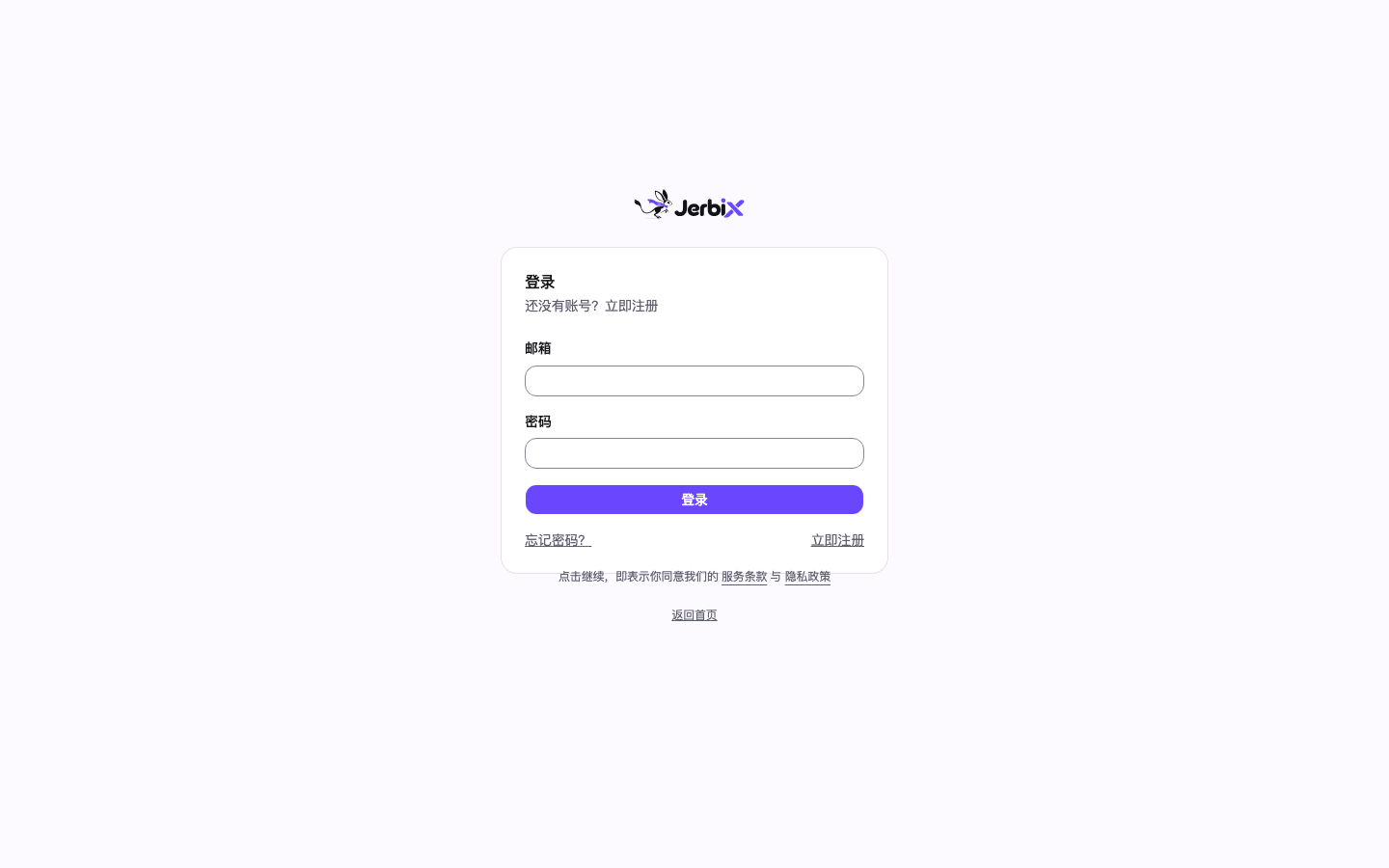
login and register render "By clicking continue, you agree to our Terms of Service and Privacy Policy" inside the form card's `CardFooter`, linking to /marketing/legal/terms and /marketing/legal/privacy in the current locale. The "Back to home" link is outside the card.
It is controlled by the legalNotice prop on AuthLayout and is off by default. Only pages where the user is actively consenting pass it: verify-email is a terminal state with no submit button, users on reset-password / forgot-password are not creating an account, and error has no action to consent to. Of register's two AuthLayout call sites, only the form one passes it — by the time "check your inbox" appears the account exists and consent already happened.
Terms and privacy content lives in content/legal/, written for Jerbix, https://www.jerbix.site, and service@jerbix.site. It covers one-time source-code purchases, MIT licensing, refunds, and actual data processing. It does not select an exclusive jurisdiction; operator identity or address disclosures may still be required by applicable operating or target-market rules. When reusing the project, adapt the content to your own operation and providers.
Production
Resend and runtime configuration
Verify your sending domain in Resend and set MAIL_FROM to a plain email address on that domain, without a display name or angle brackets. Locally, configure RESEND_API_KEY, MAIL_FROM, and BETTER_AUTH_URL in .env. In the GitHub production Environment, set Secret RESEND_API_KEY and Variable MAIL_FROM, without a `VITE_` prefix. The workflow also accepts Secret MAIL_FROM, with the Variable taking precedence, and uploads both fields through the --secrets-file allowlist. For manual deployments, values used for validation in .env.production must match Worker runtime bindings; see Email and Cloudflare.
`BETTER_AUTH_SECRET`
For a manual production deployment, upload the runtime secret with Wrangler; do not commit it:
printf '%s' "$BETTER_AUTH_SECRET" | pnpm exec wrangler secret put BETTER_AUTH_SECRETIt must be at least 32 characters; generate one with openssl rand -base64 32. Missing or short production secrets are rejected by validateProdServerEnv, so pnpm deploy fails at validation. The copy in .env.production satisfies validation; runtime reads the Worker secret. The values must match. Automatic Release deployment uses GitHub configuration and uploads the runtime binding; see Environment variables.
`BETTER_AUTH_URL`
This is the absolute base URL for callbacks and redirects. If empty, Better Auth derives it from the request origin and warns that the base URL is unset. Set it explicitly for Google OAuth or email verification so callback URLs and email links do not vary with the request origin. Use the real HTTPS origin in production, matching VITE_BASE_URL.
Google OAuth callback URL
Configure the OAuth client in Google Cloud Console with:
| Field | Value |
|---|---|
| Authorized JavaScript origin | https://your-domain.com |
| Authorized redirect URI | https://your-domain.com/api/auth/callback/google |
Also register http://localhost:3000 and http://localhost:3000/api/auth/callback/google for local development. One client can include both environments. Leave both GOOGLE_CLIENT_ID and GOOGLE_CLIENT_SECRET empty if unused; the provider and button remain absent.
Production currently uses https://www.jerbix.site, so the redirect URI must be https://www.jerbix.site/api/auth/callback/google. Configure the credentials in the GitHub production Environment as GOOGLE_CLIENT_ID and GOOGLE_CLIENT_SECRET. The workflow accepts either a Variable or a Secret for both, but Secret is safer — a client secret must never reach the client bundle.
Google sign-in is not blocked by `requireEmailVerification`: Google returns email_verified, and Better Auth marks the account verified accordingly. Only the email/password path returns 403 for unverified accounts.
Key invariants when changing this
Check each before touching auth code:
requireEmailVerificationdoes not followmail.enabled;truewith incomplete mail
config is rejected by check:env:prod.
- Where sign-up lands is decided by
signUpOutcome()— do not unconditionally say
"check your inbox".
- Social credential visibility must go through a server function
(fetchAuthProviderAvailability).
- Submit buttons must be disabled before hydration.
- Auth forms must set
noValidateon the<form>:<Input type="email">triggers native
constraint validation, which blocks submit outright on an invalid value, so schema validation and its error messages would never run.
- Email callbacks must never throw; a throw takes sign-up/sign-in down with it.
- Protected routes check the session in
beforeLoadwithfetchSession()andredirectto
the login page when signed out.
References
- Better Auth options —
BETTER_AUTH_SECRETand other settings - Better Auth Google provider — Google credentials and setup
- Google OAuth 2.0 for web server applications — the authorization code flow
- TanStack Start authentication guide — sessions, protected routes, server functions